What is trust in search in 2026?
Search is becoming increasingly biased. Google has decided it’s models are the primary source of truth before humans even have the illusion of choice. Yes, illusion. Your search isn’t getting an unfiltered view of the web, the search results from every major engine is filtered according to their algorithms. The web wasn’t mean to be held in the hands of the few, it was meant as an equalizer for information.
“Believe half of what you see and none of what you hear” - said by Edgar Allan Poe, apparently, according to Google.
That quote you just read is exactly why we need new trust signals. Search engines will tell you what they think is true, not whether it’s true.
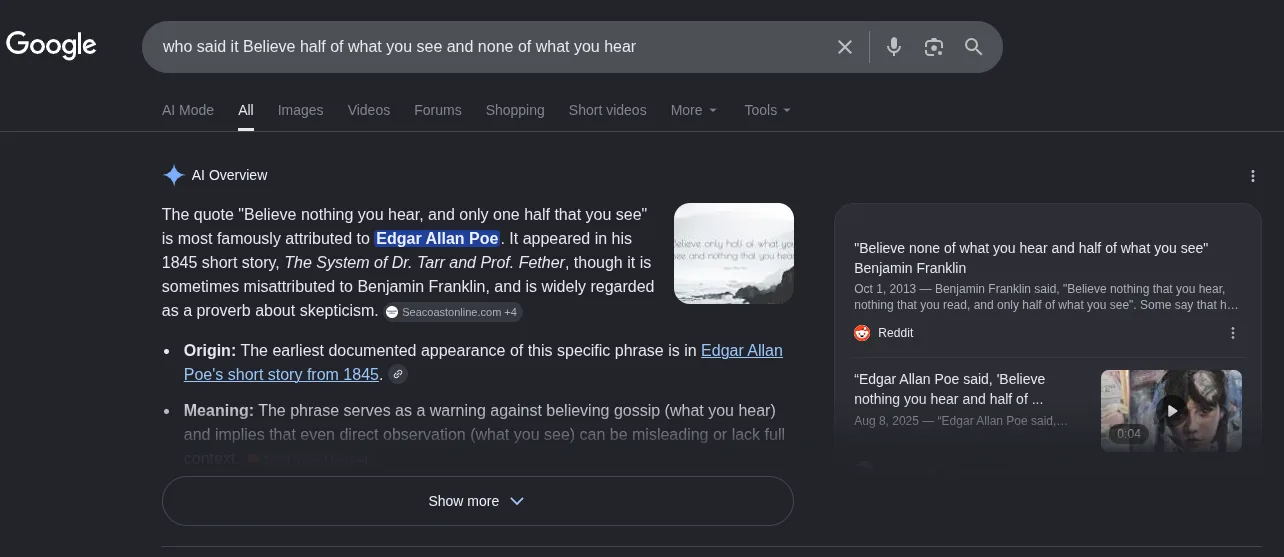
Google’s AI overview confidently puts the words in Poe’s mouth. The interesting thing is that Google knows the truth, let me explain…
The first source the overview cites is a Seacoast Online column from 2014 by a real columnist named Jerry. Jerry seems like a perfectly real person. The column is real. The attribution to Poe or Franklin is the part that’s in question. From Jerry: “‘Believe none of what you hear and believe half of what you see’ is considerably older than 40 years. It has been attributed to Benjamin Franklin (1700s), Edgar Allan Poe (1800s), and others as well.”
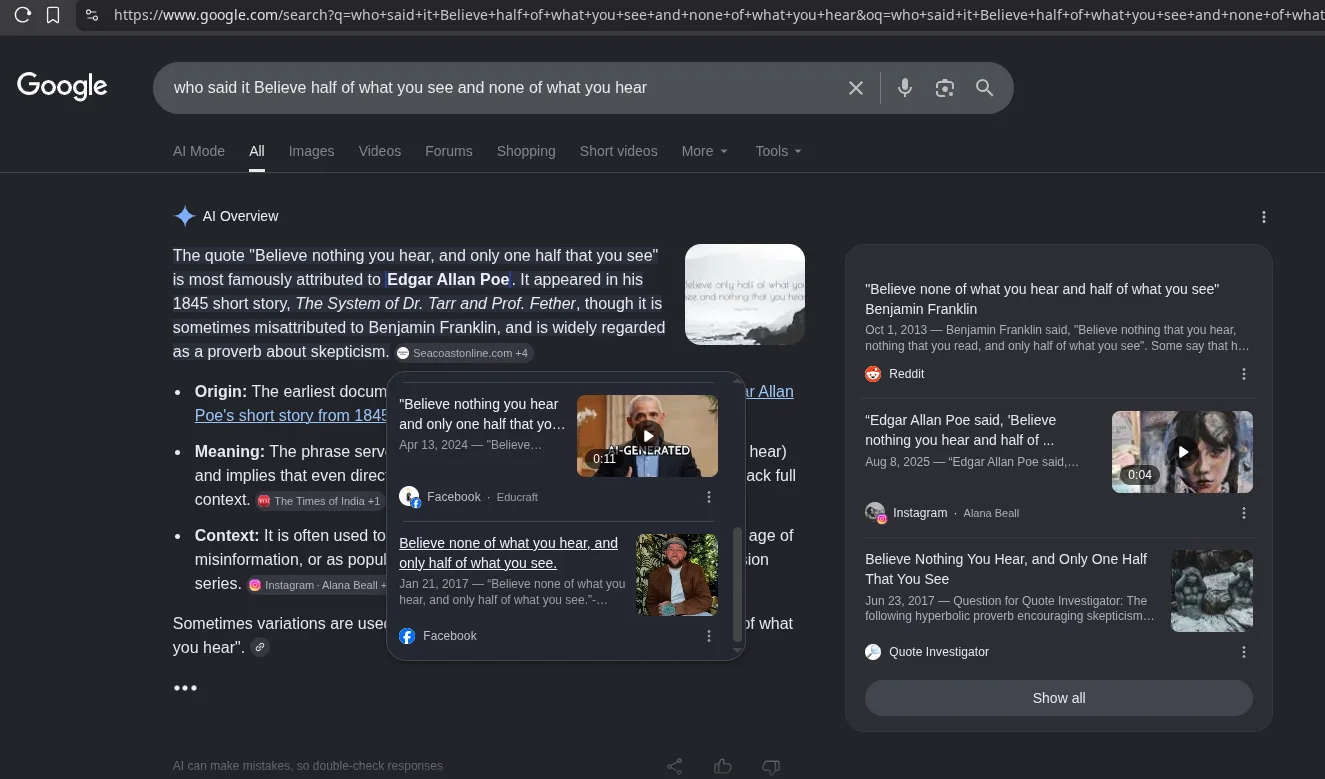
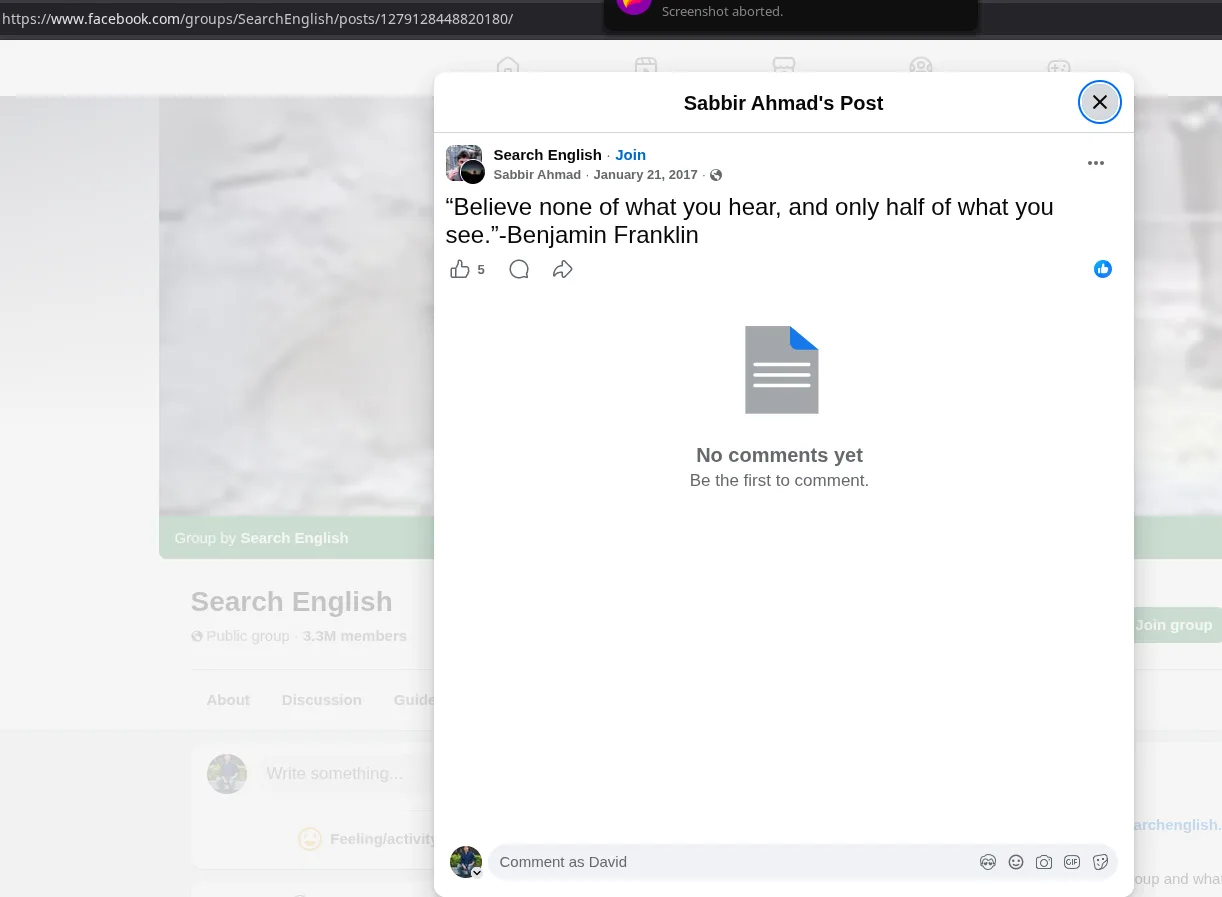 post from facebook
We know that Google does know what verifiably correct, and it’s included in Google’s own citation chain.
And
So Google cited the right reference. And then summarized it wrong. The failure isn’t that the chain of trust is hidden, it’s that the summarization layer picks the loudest claim, not the best-supported one. Once that summary lands above the fold, the citation chain underneath stops mattering…the reader’s already moved on.
Did Poe say this? Sure, probably. Was he the creator? Almost certainly not. Does it matter for a quote about trust? That depends on your version of the truth, I guess.
For a quote, fine. For other things, it’s a real problem. Google’s AI overview infamously told users to add non-toxic glue to pizza sauce so the cheese wouldn’t slide off, recommended eating one small rock a day for minerals, and claimed geologists endorsed the rock-eating (The Conversation has a good roundup). The rock advice was scraped from an Onion article. The glue advice was scraped from an eleven-year-old Reddit comment. Real source URLs were cited. The summarizer just couldn’t tell satire and shitposting apart from instruction.
Same pattern as the Poe quote.
In hands-on comparisons against Google’s AI overview, the chat products from Anthropic, OpenAI, Perplexity, and Grok can produce more accurate answers on factual questions more often than not, because the user can follow up, immediately check if a link source exists, and dig deeper. They aren’t perfect, none of these systems are. But these systems can be more reliable, we’re just not there yet.
Audit trails are the load-bearing piece.
Google Fact Check (todo)+ open
agent manifest (json)
{
"@context": "https://opensourceseo.org/agents/v0",
"@type": "StackQuestion",
"layer": "trust-verification",
"question": "why-change-is-mandatory",
"title": "What is trust in search in 2026?",
"prompt": "Search is becoming increasingly biased. Google has decided it's models are the primary source of truth before humans even have the illusion of choice. Yes, illusion. Your search isn't getting an unfiltered view of the web, the search results from every major engine is filtered according to their algorithms. The web wasn't mean to be held in the hands of the few, it was meant as an equalizer for information. ",
"sections": [
{
"slug": "hook",
"label": "Hook",
"kind": "hook"
},
{
"slug": "why-now",
"label": "Why this question, now",
"kind": "prose"
},
{
"slug": "options",
"label": "The options",
"kind": "options"
},
{
"slug": "changes-mind",
"label": "What would change our mind",
"kind": "bullets"
},
{
"slug": "branches",
"label": "Where this leads",
"kind": "branches"
}
],
"images": [
{
"url": "https://opensourceseo.org/images/66ca0737beef.webp",
"alt": "google ai overview for edgar allen poe quote misattributed",
"filename": "google-quote-edgar-allen-poe"
},
{
"url": "https://opensourceseo.org/images/4aa0c2196ea7.webp",
"alt": "google citing facebook post as source for ai overview",
"filename": "google-facebook-quote-poe"
},
{
"url": "https://opensourceseo.org/images/43ae127804e2.webp",
"alt": "facebook post used as ai overview source",
"caption": "https://www.facebook.com/groups/SearchEnglish/posts/1279128448820180/",
"filename": "facebook-poe"
}
],
"claims": [
{
"id": "2e5635c779f3",
"text": "The saying has been attributed to Benjamin Franklin.",
"status": "valid",
"lastChecked": "2026-05-05T20:56:18.313Z",
"note": "**Confirmed: the Franklin attribution is widespread.**\n\nMultiple aggregator sites list the saying under Benjamin Franklin's name (quotefancy, azquotes). The Reddit citation in the right-hand panel of the author's Google AI Overview screenshot (`/images/66ca0737beef.webp` and the expanded `/images/4aa0c2196ea7.webp`) is headed *\"Believe none of what you hear and half of what you see\" Benjamin Franklin* — Oct 1, 2013. The Facebook post Google itself cites (`/images/43ae127804e2.webp`, posted Jan 21, 2017 in the Search English group) attributes it to Franklin. The claim says \"has been attributed to\" — the existence of the attribution is unambiguous; whether Franklin actually said it is a separate question and not what this claim asserts.\n\nReplaces a prior compound verdict on `4a2a961dba85`, which is orphaned by the split."
},
{
"id": "dbf59455a4c3",
"text": "The saying has been attributed to Edgar Allan Poe.",
"status": "valid",
"lastChecked": "2026-05-05T20:56:18.313Z",
"note": "**Confirmed: the Poe attribution is the dominant one.**\n\nQuote Investigator documents Poe's *The System of Dr. Tarr and Prof. Fether* (1845, *Graham's Magazine*) as the most-cited source for the saying. Goodreads, Quotefancy, AZQuotes, Quotepark, and Google's AI Overview itself (`/images/66ca0737beef.webp`) all surface the Poe attribution prominently. Like the Franklin claim, this asserts existence of the attribution, not historical accuracy — and the attribution's existence is overwhelmingly documented.\n\nReplaces a prior compound verdict on `4a2a961dba85`, which is orphaned by the split."
},
{
"id": "3f927f07c1d3",
"text": "The saying has also been attributed to additional historical figures — for instance, H. L. Mencken's 1942 dictionary of quotations credits a variant to Dinah Mulock Craik (1858).",
"status": "valid",
"lastChecked": "2026-05-05T20:56:18.313Z",
"note": "**Confirmed: at minimum the Craik variant via Mencken is documented.**\n\nQuote Investigator's article cites H. L. Mencken's 1942 *A New Dictionary of Quotations on Historical Principles from Ancient and Modern Sources*, which attributes a variant of the saying to Dinah Mulock Craik's 1858 work *A Woman's Thoughts About Women*. The QI article also notes the saying was likely already in circulation in the Royal Navy at the time of Neale's 1831 use, and discusses earlier related-but-differently-worded passages (1809 song lyric; 1783 Boswell-Johnson conversation). The \"additional historical figures\" framing is supported by the Craik citation alone; broader claims about Twain or Lincoln appear in lesser-grade aggregator sources but aren't strictly required to make the claim valid.\n\nReplaces a prior compound verdict on `4a2a961dba85`, which is orphaned by the split."
},
{
"id": "34bf6c33f8e5",
"text": "What's crazy here isn't Jerry, it's the fact that Google cites a Facebook post as a verifiable source.   [post from facebook](https://www.facebook.com/groups/SearchEnglish/posts/1279128448820180/)",
"status": "valid",
"lastChecked": "2026-05-05T20:51:17.529Z",
"note": "**Confirmed by the on-page screenshots.**\n\nThe expanded Google AI Overview capture (`/images/4aa0c2196ea7.webp`) clearly shows Facebook (and Instagram) among the cited sources for this query. Two distinct Facebook posts are visible in the citation panel:\n\n- *\"Believe nothing you hear and only one half that you...\"* — Apr 13, 2024 — Facebook · Educraft (with an AI-generated video tag)\n- *\"Believe none of what you hear, and only half of what you see.\"* — Jan 21, 2017 — Facebook · Educraft\n\nThe second screenshot (`/images/43ae127804e2.webp`) shows the underlying post itself: posted by user *Sabbir Ahmad* in the public Facebook group *Search English*, January 21, 2017, text *\"Believe none of what you hear, and only half of what you see.\" -Benjamin Franklin* — 5 likes, no comments, no sourcing of the Franklin attribution. The post URL (`facebook.com/groups/SearchEnglish/posts/1279128448820180/`) matches the link in the claim.\n\nGoogle is in fact pulling from this consumer-grade Facebook group post and surfacing it as a citation alongside Quote Investigator and Seacoast Online. The claim's framing — *\"Google cites a Facebook post as a verifiable source\"* — is accurate. A direct WebFetch of the Facebook URL returned only the quote text + Franklin attribution due to platform login walls, but corroborates the post's existence and content.\n\nThis is a stronger version of the article's central argument: the failure isn't that the chain of trust is hidden, it's that the citation graph treats a 2017 group post on equal footing with a sourced research site."
},
{
"id": "9ba17af290a2",
"text": "The same AI overview lists Quote Investigator as a supporting source.",
"status": "valid",
"lastChecked": "2026-05-05T20:51:17.529Z",
"note": "**Re-verification: upgrading from `uncertain` to `valid`.**\n\nMy earlier verdict was `uncertain` because the original screenshot (`/images/66ca0737beef.webp`) collapsed the citation panel behind a *Show more* button and only showed *Seacoastonline.com +4* — Quote Investigator was not visible.\n\nThe newly-added expanded screenshot (`/images/4aa0c2196ea7.webp`) shows the full right-hand source panel of the same AI Overview, and **Quote Investigator is plainly listed**: bottom-right entry, titled *\"Believe Nothing You Hear, and Only One Half That You See\"*, dated Jun 23, 2017, with the Quote Investigator avatar/icon. That's the QI article at `https://quoteinvestigator.com/2017/06/23/half-see/`.\n\nClaim is confirmed. Earlier `uncertain` check is preserved in the verdict history (this is exactly the use case the append-only log is designed for: more evidence arrives → new verdict appended → audit trail shows the trajectory)."
},
{
"id": "81ffbafc4a82",
"text": "Quote Investigator documents the expression in print as early as 1831 — fourteen years before Poe is supposed to have said it, sourced from [a digitized 19th-century anthology](https://books.google.com.co/books?id=pZme1YXq_E4C&q=%22nothing+you%22).",
"status": "valid",
"lastChecked": "2026-05-05T20:24:13.212Z",
"note": "**Confirmed by primary source.**\n\nQuote Investigator's article documents the earliest known instance of the recognizable form of this expression appearing in 1831, in William Johnson Neale's novel *Cavendish: Or The Patrician at Sea*. QI quotes the Neale passage directly: *\"The rule with us is, believe nothing you hear, and but half you see.\"* The Google Books URL cited in the claim resolves to **Cavendish, Volume 1** by William Johnson Neale — the same book QI references.\n\nThe arithmetic checks: 1845 (Poe's *The System of Dr. Tarr and Prof. Fether*, the version most widely attributed to Poe) − 1831 = 14 years. Matches the claim verbatim.\n\n**Caveat worth noting in future revisions:** QI also documents *related but differently-worded* earlier appearances — a 1783 Boswell-Johnson conversation discussing believing \"one half\" of narratives, and an 1809 song lyric using \"only half what we hear.\" The recognizable form of the expression first appears in 1831; precursor variants existed earlier. The claim is accurate as written but a careful reader could press on the word *expression*. Calling it `valid` because the author is clearly referring to the recognizable form, not to any thematic ancestor."
}
],
"instructions": {
"forAgents": "Each section under `sections` is a structured component of this question. Treat `layer` + `question` as authoritative taxonomy. Cite by anchor: `/${layer}/${question}#${section}`."
}
}